
Artificial Intelligence (AI) has rapidly transformed industries over the past decade, and 2025 is set to be a landmark year for its impact on jobs and business operations. From automating repetitive tasks to enabling advanced decision-making, AI actively reshapes how organizations operate and how professionals approach their careers.
Businesses, both large and small, actively use AI-driven tools to enhance efficiency, improve customer experiences, and gain a competitive edge. At the same time, employees learn to adapt to new roles that require human-AI collaboration. This blog explores how AI transforms jobs and businesses in 2025, the benefits, challenges, and what the future holds.
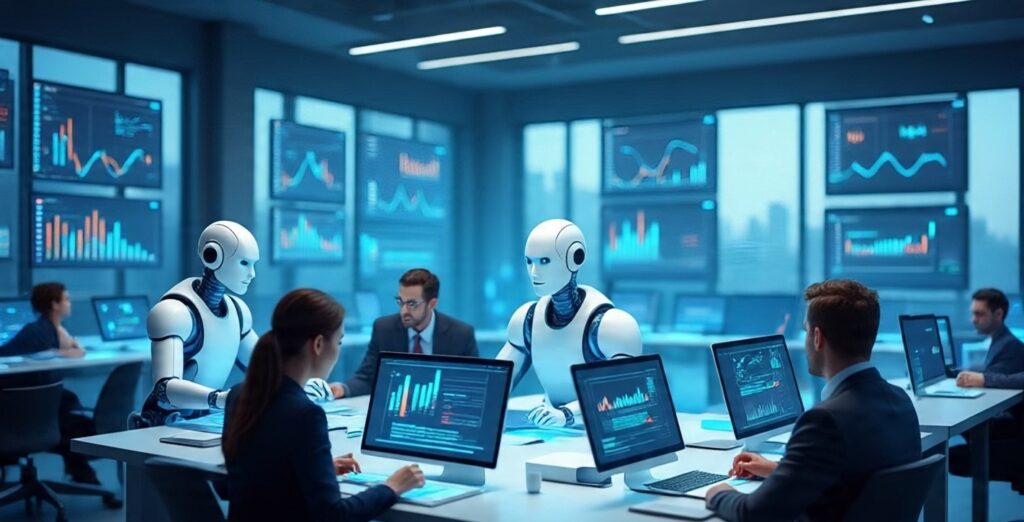
AI in the Workplace: Transforming Job Roles
AI technologies such as machine learning, natural language processing, and robotic process automation actively change how work is done:
- Automation of Repetitive Tasks: AI-powered tools handle routine tasks in finance, HR, and customer service, freeing employees for higher-value work.
- New Job Opportunities: AI creates roles in data science, AI ethics, machine learning engineering, and automation strategy.
- Upskilling & Reskilling: Professionals continuously learn new skills to work alongside AI systems, blending human creativity with machine efficiency.
In 2025, the workforce must adapt to AI-driven processes. Employees who treat AI as a tool rather than a replacement will thrive.
AI and Business Transformation
Businesses across sectors actively use AI to streamline operations, reduce costs, and enhance customer satisfaction.
- Data-Driven Decision Making: AI algorithms analyze large datasets and provide actionable insights, helping businesses make smarter, faster decisions.
- Customer Experience Enhancement: Chatbots, virtual assistants, and recommendation systems deliver personalized experiences that increase engagement and loyalty.
- Operational Efficiency: AI-driven automation reduces errors, speeds up workflows, and optimizes supply chains and inventory management.
- Innovation Acceleration: Companies deploy AI to predict market trends, develop products, and create new business models.
By 2025, businesses that adopt AI strategically become more agile, competitive, and resilient, even in a rapidly changing economic landscape.
Challenges of AI Adoption
While AI offers numerous benefits, organizations and employees face challenges:
- Job Displacement: Some routine roles may become obsolete, requiring workers to reskill.
- Data Privacy & Security: AI systems rely on large datasets, creating concerns about privacy and cyber threats.
- Bias in AI: Poorly designed algorithms can perpetuate bias and affect decision-making fairness.
- Cost of Implementation: AI adoption requires significant investment in technology and talent.
Addressing these challenges ensures responsible AI adoption and benefits both businesses and employees.
The Future of Jobs with AI
The workplace in 2025 will emphasize human-AI collaboration rather than replacement. Key trends include:
- Hybrid Roles: Professionals will combine analytical, creative, and technical skills to work alongside AI.
- AI-Augmented Creativity: Marketing, design, and R&D teams will use AI to generate ideas and optimize outcomes.
- Continuous Learning: Lifelong learning and adaptability remain essential to keep up with AI-driven changes.
- Gig Economy & Freelancing: AI platforms enable remote work, freelance projects, and global collaborations.
Workers who embrace AI as a growth tool will enjoy enhanced productivity, career mobility, and innovation opportunities.
FAQs
1. Will AI take away jobs completely?
AI will automate repetitive tasks, but it also creates new roles that require human creativity, empathy, and problem-solving.
2. How can employees prepare for AI-driven workplaces?
Employees should upskill in data analysis, AI ethics, machine learning basics, and digital tools to thrive alongside AI.
3. Which industries benefit the most from AI in 2025?
Finance, healthcare, retail, logistics, marketing, and manufacturing actively leverage AI for efficiency and growth.
4. Is AI adoption expensive for small businesses?
Although initial costs exist, many cloud-based AI solutions offer affordable options for small and medium businesses.
5. How does AI enhance customer experience?
AI uses data to personalize interactions, provide real-time support through chatbots, and offer recommendations tailored to individual preferences.
Conclusion
Artificial Intelligence is no longer optional; in 2025, it actively reshapes jobs, businesses, and industries globally. While AI automates routine tasks, it also creates opportunities for innovation, productivity, and career growth. By adopting AI responsibly and embracing continuous learning, businesses thrive, and employees secure fulfilling roles in an evolving digital workplace.
AI is not just a tool—it acts as a catalyst for transformation, enabling smarter decision-making, operational efficiency, and enhanced human creativity.